Cracking CAT isn’t just about finishing the syllabus or slogging through endless practice
books. It’s about putting your effort into smart practice—tackling the right questions at the
right time. Every year, thousands of students dive into CAT Previous Year Questions (PYQs)
to get a feel for the exam. But here’s the thing: the serious toppers don’t stop with PYQs.
They mix them up with AI Predicted Mock Tests that can keep up with the shifting trends and
difficulty of the real CAT.
If you’re aiming for an IIM or a top B-school, combining these two gives your prep a major
boost.
Why are CAT Previous Year Questions So Useful?
PYQs are more than just practice—they’re your gateway into how CAT really works. They
show you:
- How the exam pattern keeps changing
- The level of difficulty across VARC, DILR, and QA
- Which concepts show up over and over
- How you should be managing your time
- What kinds of questions each section throws at you
Instead of making you memorize formulas, they teach you how CAT likes to test your logic
and analytical skills.
Benefits of Practicing CAT PYQs
- You get familiar with the real questions—no surprises on test day
- You figure out how questions are actually set
- Your speed and accuracy keep improving
- It’s easier to spot your weak topics
- That pre-exam jitters? Less of a thing when you know what to expect
If you’re picking papers, stick to the last 5–7 years. They match what you’ll really see.
Why PYQs Are Not Enough
A lot of folks do the same PYQs again and again until they know every answer by heart. But
that won’t cut it. CAT changes up its difficulty, question structure, and especially the DILR
sets each year. If you just stick to old patterns, you’re preparing for last year’s exam, not the
next one.
This is where AI Predicted Mock Tests come in—they mirror the kind of twists you’ll face
ahead.
AI Predicted CAT Mocks: How They Change the Game
Artificial Intelligence is flipping exam prep on its head.
AI-driven mocks look at all sorts of real CAT data—the patterns, the weight of different
topics, how difficulty ramps up, which new question styles show up, and how you’re
performing section by section.
With this, the AI builds fresh mocks that are crazy close to what you’re likely to see in your
attempt. You’re not just practicing random stuff. You’re practicing the right stuff.
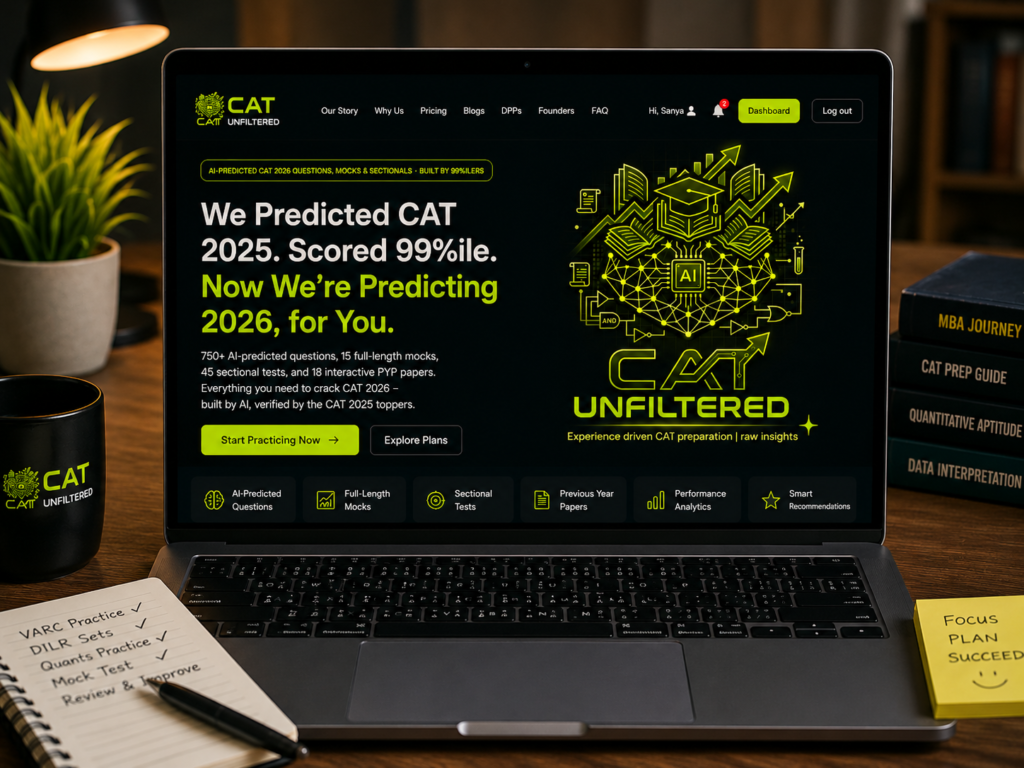
Why Cat unfiltered ’s AI Mocks?
Cat unfiltered ’s AI Mocks go a step further. They don’t just give you a tough paper—they
actually create an environment that feels like real CAT and point out your weak zones.
Here’s why people love them:
- AI-Based Question Prediction
They’re not static. The questions are built after analyzing recent trends. You get practice that
keeps up with how CAT is changing. - Detailed Solutions
Every question comes with a proper, stepwise explanation. You learn “how” and “why”—not
just the final answer. - Performance Analysis
After each mock, you can see:
- Where you got it right (and wrong)
- How fast you answered
- Which topics are your strengths
- Which are slow or shaky
- Where you can clean up your act
- Real CAT Feel
From the interface to the pacing and toughness, you get the most genuine simulation outside
of the actual exam hall.
CAT Previous Year Questions vs AI Predicted Mocks
CAT Previous Year Questions AI Predicted CAT Mocks
Actual CAT questions Predicted future-style questions
Understand past trends. Prepare for upcoming trends
Build conceptual clarity. Improve adaptability
Limited question pool. Fresh practice every time
Strong for revision, strong for exam simulation
Bottom line: You need both.
How to Mix PYQs with AI Mocks (The Real Prep Plan)
Phase 1: Get Your Basics Right
Brush up on Arithmetic, Algebra, Geometry, Modern Math, VARC, and DILR. Build a solid
foundation.
Phase 2: Work Through CAT PYQs
First, solve them topic by topic. Then, try full-length sections, timing yourself the same way
as the main exam.
Phase 3: Dive Into AI-Predicted Mocks
Once you’re comfy with previous years, start taking a mock every week. Pay attention to:
Managing your time
Facing new kinds of questions
Keeping your cool under pressure
Sharpening accuracy
Phase 4: Analyze Every MockDon’t just finish a test and move on. Sit down with your mistakes and ask:
Why’d I mess this one up?
Was I slow, or did I not get the approach?
Which topics do I keep missing?
Is it a silly slip or am I clueless here?
Most real improvement happens in this honest review.
Section-Wise Tips
VARC
Tackle reading comprehension, para summary, jumbles, odd one out. Always go through the
Solutions carefully—the insights help boost your reading speed and understanding.
DILR
Focus on picking the right set, then work through the logic, interpretation, and puzzles. AI
mocks are especially good for getting you used to newer or trickier formats, stuff not covered
in PYQs.
Quantitative Aptitude
Cover all the bases: arithmetic, algebra, geometry, number systems, modern math. Always
Practice with a timer—you want to be fast and accurate.
Don’t Fall Into These Common Traps
Racing through PYQs without stopping to figure out mistakes
Just taking mock after mock and never learning from them
Skipping sectional tests
Hiding from the tough sets or sticking to questions you find easy
Ignoring time management
Watch out for these. Dodging these mistakes gives you a real edge.
Why Detailed Solutions Matter More Than Your Score
Chasing a high score feels good, but the real winners are the ones who care about solutions.
Every detailed explanation:
Teaches you shortcuts and better methods
Opens you up to new approaches
Stops you from repeating silly errors
Strengthens your fundamentals
Every “wrong” is a free lesson—treat it like gold.
Wrapping Up
CAT isn’t about doing the most questions. It’s about doing the right ones the right way, and
learning as you go. Start with PYQs to get comfortable, shift to AI Predicted Mocks to stay
ahead of the curve, and always review what you did right or wrong.
If you’re serious about CAT 2026, make CAT PYQs, detailed solution analysis, and AI
Predicted Mocks your new routine.
You can check out Cat Unfilteredfor structured practice,
AI-driven mocks, and detailed solutions that actually help you grow.
Frequently Asked Questions
- Are CAT previous year questions alone enough?
Nope. They’re essential, but if you stop there you won’t be prepared for what’s new. AI
Predicted Mocks help fill the gap by matching the latest trends. - How many CAT previous year papers should I solve?
At least the last 5–7 years, all slots included. It’s the best way to understand what CAT tests
now. - What’s special about AI Predicted CAT Mocks?
They look at past trends and generate practice tests that match what you’ll likely face in your
CAT attempt—so you’re always in sync. - When should I start taking mocks?
Once you’ve got your basics sorted. Start with one mock a week, and ramp it up closer to the
exam. - How important is analyzing mocks?
It’s critical. Simply taking tests isn’t enough. The insights you get from your analysis—your
mistakes, your strengths, how you solved—are often worth more than taking another mock. That’s where you grow.